



When disasters happen, it’s important to know the risks and how to stay safe. In Europe, air-raid sirens have been used since World War II, but today we also use digital tools to warn people, like smartphone applications, texts, websites, and social media. Examining how digitalization transforms public emergency communication in the Nordic countries, the DIGeMERGE project (Digital Emergency Communication) project has explored the introduction of new emergency communication technologies in Norway, Sweden, Finland and Denmark, and the implications of these transformations for citizen-state relations. The DIGeMERGE consortium consisted of the Peace Research Institute Oslo (Norway), Malmö University (Sweden), IT University of Copenhagen (Denmark) and Centre for Machine Vision and Signal Analysis, University of Oulu (Finland). The main objective of DIGeMERGE was to understand the everyday challenges of the digitalisation of emergency services, and what this means for the relationship between the state and its citizens.
Video produced by: Chocolate Films with support from CHANSE Knowledge Exchange.
Tags: digitalisation, emergency, equality and inclusion, transformation, values and trust.
The discussion concluded the final conference of the DIGISCREENS project. Stakeholders from France, Spain, Norway, Sweden, and Lithuania were invited to discuss the main themes of the project: “Identity and Democratic Values in the Age of Streaming”. Meno Avilys Cinematheque, Vilnius, 24th of October 2025.
Participants (seated from left to right): Anna Serner (former CEO of the Swedish Film Institute), Klara Nilsson Grunning (Film Commissioner, Western Norway Film Fund), Marie-Lou Dulac (Diversity and Inclusion Consultant and Founder of the DIRE & Dire Agency), Kristina Zorita (Women Filmmakers Association, Basque, Spain), Dagnė Vildžiūnaitė (Independent Film Producer, Lithuania), and Giovanna Ribes (Filmmaker, Co-Director of the Dona i Cinema Association). Moderator: Maud Ceuterick, University of Bergen.
Tags: recording, identity, digitalisation, equality and inclusion, platform, transformation.
The GEiO project Final Conference promotion video, capturing key moments from the event.
Tags: equality and inclusion, work and labour, technology at home.
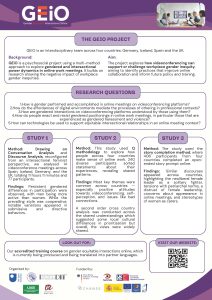
Poster providing an overview and findings of the Gender Equitable Interactions Online (GEiO) research project. The poster covers the three studies that comprise the project along with a summary of results and outputs.
Tags: equality and inclusion, work and labour, technology at home.
This video is a carousel presentation of key moments throughout the duration of the three year GEiO Project including conference presentations, elements of the GEiO badged course “Are you on Mute? Best practice in online meetings”, and key findings.
Tags: equality and inclusion, work and labour, technology at home.
The SMARTUP project (CHANSE, 2022–2025) explores how digital infrastructures within homes impact daily life and often reinforce traditional divisions of labour and responsibility in different-sex couples, despite the promise of comfort and automation. Drawing on one work package based on 30 interviews in Germany, Poland, and the Czech Republic, this video highlights how men frequently take on the role of household “tech gurus,” while women continue to carry the bulk of caregiving and domestic responsibilities. We emphasize the need to design smart technologies that support equity and inclusivity in everyday domestic life.
Tags: equality and inclusion, digital skills, technology at home, work and labour.
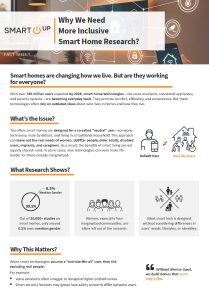
This fact sheet addresses the exclusionary consequences of designing smart homes around a so-called “neutral” user—typically imagined as tech-savvy, male, and living in a traditional household. Such assumptions overlook the needs of women, LGBTQ+ people, older adults, disabled users, migrants, and caregivers, leading to unequal access to the benefits of smart technologies and, at times, reinforcing existing vulnerabilities. The document argues that building equitable smart homes requires a collaboration, and attention to marginalized voices as key steps toward shaping smart homes that empower rather than exclude, and that contribute to a fairer and more humane digital future. The fact sheet is part of the EU funded SmartUp project (2022–2025) exploring the digital transformation of the home paradigm shift: from designing for an abstract user to engaging with the full diversity of real domestic lives. It emphasizes participatory approaches, cross-sector
Tags: equality and inclusion, design, technology at home, data use.