


During disasters and emergencies, good communication is of vital importance to life-saving efforts. In recent years, numerous digital tools have made their way into emergency management, initially simply to warn the public about imminent risks and hazards. As societies become ever more digitalised, such tools are increasingly used to collect data from the public and those at risk, including user-generated content posted on social media also known as many-to-many communication platforms.
The CHANSE research project Digital Emergency Communication (DIGeMERGE) studies the use of many-to-many and other digital communication platforms and tools in four highly digitalised European countries; Norway, Sweden, Finland and Denmark. Using a grounded, applied approach, DIGeMERGE examines the scope and implications of the digitalisation of emergency communication in these countries, covering debates about privacy and data protection, and efforts to integrate user-generated content into emergency responses. Digital communication tools under study include pandemic tracing apps and other smartphone applications that use location data, mass alerts via text message and the use of social media platforms like Twitter and Facebook for issuing advice as well as situational data collection.
The overarching objective of DIGeMERGE is to understand both the everyday practical challenges of emergency service digitalisation and the deeper implications for the state-citizen relationship. The project pursues this objective by investigating challenges associated with new digital emergency communication tools and related debates about societal and individual responsibility, protection needs, vulnerability and rights.
DIGeMERGE is led by Åshild Kolås at the Peace Research Institute Oslo (PRIO) and includes Stine Bergersen as co-investigator from PRIO. The research team also consists of principal investigators Linda Paxling at Malmö University in Sweden, Sunniva Sandbukt at the IT University of Copenhagen in Denmark and Mourad Oussalah at the Centre for Machine Vision and Signal Analysis, University of Oulu in Finland. In addition to the researchers, DIGeMERGE further involves stakeholder cooperation partners, including the NGO Norwegian People’s Aid, a major rescue service organisation in Norway, and Finland’s 6G Flagship programme. DIGeMERGE also has a stakeholder reference group of emergency management practitioners, which is geared towards knowledge co-production.
For more information and updates: https://www.prio.org/projects/DIGeMERGE
KEYWORDS:
emergency communication, crisis communication, digitalisation, rights, innovation, emergency management, contact tracing, emergency response
CONSORTIUM
- Project Leader: Åshild Kolås, Peace Research Institute Oslo (PRIO), Dimensions of Security, Norway, e-mail
- Linda Paxling, Malmö University, Sweden
- Sunniva Sandbukt, IT University of Copenhagen, Denmark
- Mourad Oussalah, University of Oulu, Faculty of Information Technology and Electrical Engineering, CMVS, Finland
COOPERATION PARTERS
- Erlend Aarsæther, First Aid and Rescue Services, Norwegian Peoples Aid
- Marja Matinmikko-Blue, Sustainability and Regulation 6G Flagship
- Bernd Bohned, Google CSG, London
- Thi Hoang, Global Initiative against Transnational Organized Crime
EFFECTS & ACHIEVEMENTS
Project achievements:
Background and objectives
DIGeMERGE was motivated by the observation that emergency services increasingly rely on digital tools such as mobile emergency alerts, mass text messaging, dedicated emergency applications, and social media platforms, while systematic, comparative knowledge about the societal and operational consequences of these developments has remained limited. The DIGeMERGE project addressed this gap by studying Norway, Sweden, Denmark, and Finland, four highly digitalised countries with strong welfare states and advanced emergency management systems, but with differing institutional arrangements and communication practices. The overarching objective was to interrogate both the practical use of digital emergency communication tools and their deeper implications for governance, responsibility, and citizenship.
How we worked
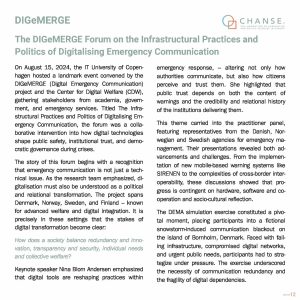
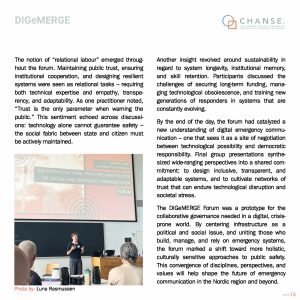
The DIGeMERGE team included researchers in Norway (Åshild Kolås and Stine Bergersen, PRIO), Sweden (Linda Paxling, Malmö University), Denmark (Sunniva Sandbukt, IT University of Copenhagen) and Finland (Mourad Oussalah and Fuzel Shaik, Centre for Machine Vision and Signal Analysis, University of Oulu). We combined qualitative case studies with computational methods and ongoing stakeholder engagement to generate practice-relevant, comparative knowledge. Core activities included: (1) systematic review of national policies and plans for emergency communication; (2) qualitative fieldwork with practitioners and stakeholders; (3) analysis of digital emergency communication infrastructures and public debate during rollouts and real-world use of new information technologies and platforms; (4) computational analysis of digital data, including user-generated feedback; and (5) sustained knowledge exchange through panels, open forums, knowledge exchange with practitioners, and public-facing outputs.
Main results
Across the four countries under study, DIGeMERGE has produced evidence that moves beyond generic claims about “digitalisation” toward concrete insights on what makes digital emergency alerting work in practice, including when alerts fail, for whom, and why. A key contribution is a systematic Nordic baseline of citizen preferences for warning channels and timing across different emergency scenarios, including how people weigh perceived benefits (safety, actionable guidance) against perceived costs (stress, irritation, disturbance). This supports proportionate, people-centred alerting strategies and informed decision-making about the use of more intrusive mobile-based alerting. DIGeMERGE has also demonstrated how user-generated data such as app reviews can be analysed to identify recurring usability problems, unmet needs, and trust-related concerns, offering a low-threshold feedback loop for continuous improvement.
Impact and use
The project is expected to generate impact through: (1) policy-oriented dissemination such as policy briefs and multimedia content (a video produced with support from CHANSE KEF); (2) capacity-building via higher education and professional training, including a Master course for professionals developed in collaboration with Nord University in Norway titled Digitalizing public emergency communication: New technologies and debates that will also be held in 2026); and (3) European-level knowledge mobilisation through engagement in the COST Action AlertHub, especially the development of an open-access knowledge platform that links and curates resources on emergency warning communication systems across Europe, in partnership with the EU Civil Protection Agency’s Knowledge Library.
Publications:
-
Gjendem, Lars & Åshild Kolås (2026) Police communication in Norway: The transition from Twitter/X to the Police Log, PRIO Policy Brief, 1. Oslo: PRIO, https://cdn.cloud.prio.org/files/dca5231c-8c84-4f7e-9107-2a403cbcfb0a/PRIO%20Policy%20Brief1%20-%202026.pdf
- Oussalah, M., Shaik, F., On mining mobile emergency communication applications in Nordic countries, International Journal of Disaster Risk Reduction, 2024, https://doi.org/10.1016/j.ijdrr.2024.104566
- Kolås, Å., Bergersen, S., This Is What Norwegians Think About Emergency Alerts on Mobile Phones, PRIO Blog, 10 January 2025, https://blogs.prio.org/2025/01/this-is-what-norwegians-think-about-emergency-alerts-on-mobile-phones/
- Kolås, Å., Shaik, F., Disinformation and Emergency Communication. Who and how do we trust, in a post-truth crisis?, PRIO Policy Brief 14, 2024, https://cdn.cloud.prio.org/files/f2357c1c-f10b-4cc8-8357-d5fbdffc112b/PRIO%20Policy%20Brief%2014-2024.pdf?inline=true
- Kolås, Å., Shaik, F., Digital Emergency Communication in the Nordic Countries (DIGeMERGE), ISCRAM Conference poster, 2024, http://dx.doi.org/10.13140/RG.2.2.12432.42242
- Shaik, F., Understanding User Behavior Aspects on Emergency Mobile Applications During Emergency Communications Using NLP And Text Mining Techniques, Master thesis, Faculty of Information Technology and Electrical Engineering, 2023
- https://oulurepo.oulu.fi/bitstream/handle/10024/43029/nbnfioulu-202310093107.pdf?sequence=1&isAllowed=y
- Kolås, Å., Bergersen, S., Dette synes nordmenn om nødvarsel på mobil, Forskersonen, 7 January 2025, https://www.forskersonen.no/beredskap-kronikk-meninger/dette-synes-nordmenn-om-nodvarsel-pa-mobil/2449734
- Oussalah, M., Shaik, F., Demil, G., Early Warning Systems for Natural Disaster Using AI to Enhance Emergency Communication and Citizen Participation, Advancements in AI and ML for Early Warning Systems in Natural Disaster Detection, 1, 2025, https://www.appleacademicpress.com/advancements-in-ai-and-ml-for-early-warning-systems-in-natural-disaster-detection-future-trends-and-innovations/9781779643964
- Sandbukt, S., Winthereik, B. R., Fibreglass and steel: De-imagineering AI value claims for Danish SMEs, Anthropological Theory, OnlineFirst, 2025, https://doi.org/10.1177/14634996251352390
- Sandbukt, S., Marttila, S., Fischer, L. H., Tracing human-AI relations: a participatory approach to GenAI integration in creative public service work, SERVDES 2025 Research Papers, Online, 2025, https://dl.designresearchsociety.org/servdes/servdes2025/researchpapers/39/
- Oussalah, M., Kumar, V., Hopfgartner, F., Rossi, P. M., Crisis communication and media influence during Nokia water contamination event, Progress in Disaster Science, 28, 2025, https://doi.org/10.1016/j.pdisas.2025.100487
- Oussalah, M., Shaik, F., Koirala, S., Xie, Q., Vithanage, S., Towards Reliable Disaster Detection: Comparing Semantic and Heuristic Filters for Multimodal Data, IPTA 2025, Online, 2025, https://ieeexplore.ieee.org/document/11222034
- Oussalah, M., Shaik, F., Acharjee, S., Towards Trustworthy Disaster Severity Scoring: Combining Semantic Alignment and Chain-of-Thought LLMs, IPTA 2025, Online, 2025, https://ieeexplore.ieee.org/document/11222004
- Oussalah, M., Shaik, F., Holappa, A., Myllymäki, O., Sotaniemi, J., Network-Based Simulation of Flood Alert Dissemination Using GDACS and Synthetic Communication Logs, ACM UbiComp Companion, 1, 2025, https://doi.org/10.1145/3714394.3754440
- Oussalah, M., Shaik, F., Lammi, M., Kupiainen, S., Evolving Structures of Interagency Collaboration in Disaster Response: A Social Network Analysis of Cyclone Idai, ACM UbiComp Companion, 1, 2025, https://doi.org/10.1145/3714394.3754439
- Oussalah, M., Munawar, M., MS-DSCLNet: A Multi-Scale Dual-Stream Contrastive Learning Network for Image Tampering Detection and Localization, IPTA 2025, Online, 2025
- Oussalah, M., Munawar, M., Deployable Image Forgery Detection and Localization: A Comprehensive Review and Practitioner’s Guide, Expert Systems with Applications, 311, 2026, https://doi.org/10.1016/j.eswa.2026.131347
- Oussalah, M., Shaik, F., Demil, G., AI-based Approach in Early Warning Systems: Focus on Emergency Communication Ecosystem and Citizen Participation in Nordic Countries, arXiv, Online, 2025, https://doi.org/10.48550/arXiv.2506.18926
- Kolås, Å., Paxling, L., Sandbukt, S., Oussalah, M., Shaik, F., Khalid, M. F., Perceived Usefulness and Public Warning Preferences: A Cross-National Study of Alert Timing and Channel Choice in the Nordics, SSRN, Online, 2025, https://doi.org/10.2139/ssrn.5591179
- Kolås, Å., Bergersen, S., Digital Emergency Communication (DIGeMERGE), Norway (Version 1), Sikt – Norwegian Agency for Shared Services in Education and Research, 2025, https://doi.org/10.18712/NSD-NSD3302-V1
- Kolås, Å., Bergersen, S., Digital Emergency Communication (DIGeMERGE), Denmark (Version 1), Sikt – Norwegian Agency for Shared Services in Education and Research, 2025, https://doi.org/10.18712/NSD-NSD3305-V1
- Kolås, Å., Bergersen, S., Digital Emergency Communication (DIGeMERGE), Sweden (Version 1), Sikt – Norwegian Agency for Shared Services in Education and Research, 2025, https://doi.org/10.18712/NSD-NSD3303-V1
- Kolås, Å., Bergersen, S., Digital Emergency Communication (DIGeMERGE), Finland (Version 1), Sikt – Norwegian Agency for Shared Services in Education and Research, 2025, https://doi.org/10.18712/NSD-NSD3304-V1
- Kolås, Å., Bergersen, S., Reconfiguring the smartphone for public notifications: Cell broadcast emergency alerts in Norway, Crisis and Risk Communication, OnlineFirst, 2025
- Kolås, Å., Crisis informatics, disinformation and emergency politics, Convergence, OnlineFirst, 2025
- Bergersen, S., From Sirens to Smartphones: Expanding Emergency Communication in Norway, Public Relations Enquiry, 2026
- Sandbukt, S., Wang, Y., Ruohonen, H., et al., Challenges and pathways to effective warning systems for extreme weather events: global insights for the European context, Journal of Contingencies and Crisis Management, 46, 2026
- Sandbukt, S., Life, death, and the standardized encoding of language for mobile-based public warning messages, Information, Communication & Society, 29, 2026
- Sandbukt, S., The Redundancy Principle: An empirical case of public sector digitalization from crisis management, Academy of Management Journal, 35, 2026
- Sandbukt, S., ‘That’s why we test!’: national warning systems and institutional boundaries, Journal of Contingencies and Crisis Management, 25, 2026
- Paxling, L., Identifying sociotechnical vulnerabilities through collective sensemaking: A Case Study of Sweden’s COVID-19 SMS campaign, Bloomsbury, 25, 2026
- Paxling, L., On call for crisis: navigating trust, social media logic, and sociotechnical systems at krisinformation.se, Information Technology & People, 25, 2026, https://www.emeraldgrouppublishing.com/calls-for-papers/crisis-driven-digital-transformation-public-sector
- Paxling, L., Socio-technical gaps in school safety, NORDICHI 2026, 30, 2026
- Paxling, L., Governing through sound: On the performativity of siren tests and the anticipation of crisis, Journal of Contingencies and Crisis Management, 20, 2026
- Oussalah, M., Zhang, Y., Causal Evidence Extraction and Triangulation in Crisis Reports using Large Language Models, ACL 2026, 9, 2026
 Start date
1 October 2022
 Project duration
36 months
 Project budget
€ 1 469 773
Funding organisations