


At a time when streaming platforms provide access to film and television from all over the world, DIGISCREENS focuses on how these platforms contribute to transform social and cultural dynamics in Europe. The project asks how the increased possibilities for audiences to watch audio-visual content from a great geographical diversity affect our construction of identity and understanding of the other, as well as our negotiation of democratic values such as equality, inclusion and solidarity.
DIGISCREENS is a transdisciplinary project that studies film and TV distribution, reception and representation in the light of the last decades’ policies for increased diversity and inclusivity on screen. In particular, we problematize how European distribution policies and individualised algorithms govern public and commercial platforms, creating both “filter bubbles” and a promise of common democratic values and models of identity.
By investigating digital film and TV distribution, representation, and reception in Norway, Sweden, France, Spain and Lithuania, this project discusses how transnational distribution and consumption of audio-visual content may create social encounters and a sense of global integration. By combining methodologies from media studies, anthropology, literature, cultural and political analysis, we compare how members of different social and cultural groups perceive their roles, rights and democratic participation in contemporary Europe.
KEYWORDS:
fiction film and tv series, digital platforms, european audiovisual market, audience studies, svod, socio-cultural identities, democratic values, equality and inclusion.
CONSORTIUM
- Project Leader: Maud Ceuterick, University of Bergen, Department of Information Science and Media Studies, Norway, e-mail
- Lina Kaminskaitė Jančorienė, Lithuanian Academy of Music and Theatre, Art History and Theory, Lithuania
- Maria Jansson, Orebro University, School of Humanities, Education and Social Sciences, Sweden, e-mail
- Adelina Sanchez, University of Granada, Instituto Universitario de Estudios de las Mujeres y de Género, Spain
COOPERATION PARTERS
- Norsk Rikskringkasting (NRI),
- Norsk Filminstitutt (NFI),
- Université Paris XIII (known as Université Sorbonne Paris Nord),
- ICAA – Spanish Film Institute,
- La Pantalla Digital (public- funded guide to digital platforms distributing cinema, series and other VOD contents in Spain),
- EWA- European Women’s Audiovisual Network,
- WIFTI – Women in Film and Television International and WIFT Sweden,
- Swedish Film Institute,
- Dones Visuals (Catalonian organisation of women in cinema and the audiovisual industry),
- Lithuanian Film Center (LKC),
- Lithuanian Radio and Television (LRT)
EFFECTS & ACHIEVEMENTS
Project achievements:
At a time when streaming platforms provide access to film and television from all over the world, DIGISCREENS focuses on how these platforms contribute to transform social and cultural dynamics in Europe. The project asks how the increased possibilities for audiences to watch audiovisual content from a great geographical diversity affect our construction of identity and understanding of the other, as well as our negotiation of democratic values such as equality, inclusion, and solidarity.
DIGISCREENS is a transdisciplinary project that studies film and TV distribution, reception, and representation in the light of the last decades’ policies for increased diversity and inclusivity on screen. On the one hand, we problematise how European and national audiovisual policies tackle issues of cultural and social diversity on screen and how global players affect national production practices and screen representations of identities and democratic values. On the other hand, we posit that fiction is crucial for constituting common frames of reference and negotiating shared values including fundamental democratic ideas such as notions of equality, diversity and inclusion.
By investigating digital film and TV distribution, representation, and reception in Norway, Sweden, France, Spain and Lithuania, this project discusses how transnational distribution and consumption of audiovisual content may create social encounters and a sense of global integration. Our methodology innovatively integrates various approaches to TV and media studies as it combines policy analysis, elite interviews -with film and TV industry actors, creators, funders and policymakers-, close analysis of television series, and audience research through focus groups with a wide variety of individuals in the five countries.
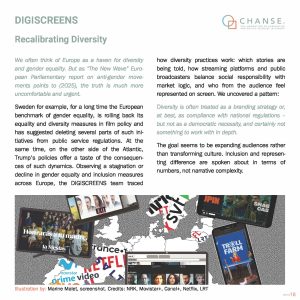
As we Investigated industry regulations of very different production markets, we found that countries with larger production capacity tended to put more stress on cultural exception than small and medium size production countries (France vs. Lithuania or Sweden), which tended to emphasise liberal markets. Further, backsliding related to gender equality and diversity were noted in some countries but not in others.
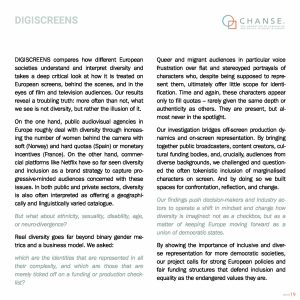
In a second instance, through textual analysis, audience and production interviews, we observe discrepancies in how diversity is understood in the film and TV industry, represented on screen and experienced by audiences. Where industry actors refer to cultural diversity or media plurality, audiences rather point to issues of identity politics in representation, which gave rise to divergent interpretations and polarised discussions, an area which would benefit from further research.
The focus groups allowed us to compare how fiction affects identity construction, the perception of others and recognition of intersectional discrimination and violence, and how these differ between members of different social and cultural groups. Notably, results regarding viewer behaviour indicate similarities across all studied countries, and corroborates previous studies, while also noting that watching streamed content remains a social activity like watching television was. Further, results from watching the French produced Netflix series Lupin indicate that audiences describe European series as being less “familiar” than US series, and that they ascribe certain features of the series as “other” compared to both the US and their own country of residence.
Publications:
- Ceuterick, M., Producing public quality drama in the streaming era: Between cultural policy, distribution strategy, and narrative risks, Critical Studies in Television, 2026
- Ceuterick, M., Malet, M. The (in)visibility of diversity on streaming platforms in France and Norway: A quantitative and qualitative visual analysis of thumbnails, Convergence: The International Journal of Research into New Media Technologies, vol.30 issue 4, 2024, https://doi.org/10.1177/13548565241270712
- Jansson, M., Viktig fråga, men vem bryr sig?,(2026), https://www.diva-portal.org/smash/get/diva2:2028963/FULLTEXT01.pdf
- Jansson, M., & Belle, J. V. (2024), Markets as free speech providers and political resignation: Swedish (non) regulation of streaming platforms, Journal of Digital Media & Policy, 15(2), 279-295. DOI: https://doi.org/10.1386/jdmp_00148_1
- Jansson, M., Calderón Sandoval, O., Oral, T., (2025) Gender equality and diversity discourses, International Journal of Cultural Policy, OnlineFirst, 2025, https://doi.org/10.1080/10286632.2025.2593352
- Jansson, M., Van Belle, J., (2025)The politics of constructing television audiences, Convergence, OnlineFirst, 2025, https://doi.org/10.1177/13548565251388146
- Van Belle, J., Aitaki, G., Jansson, M. (2025) Audiovisual fiction and democracy, Nordicom Review, 46(1), 2025, https://doi.org/10.2478/nor-2025-0008
- Malet, M., La dimension collective et sociale des séries dystopiques à l’épreuve du streaming. Enquête sur les pratiques de visionnage et les réceptions des séries dystopiques en contexte numérique, In: V. Bullich & L. Schmitt (eds.),Les plateformes de vidéos à la demande en France. Au-delà de Netflix et YouTube, Editions des archives contemporaines, (2025). https://doi.org/10.17184/eac.9171
- Calderón-Sandoval, O., Medina-Bravo, P., & Sánchez-Espinosa, A. (2026). The (neoliberal) feminism of global SVOD platforms, Netflix’s inclusion policy, and the negotiations of women audiovisual creators: two Spanish case studies. Feminist Media Studies, 26(5), 1445–1460. https://doi.org/10.1080/14680777.2025.2504498
- Calderón-Sandoval, O., Rivera-Izquierdo, A., & Sánchez-Espinosa, A. (2024) Race-ing Masculinity: An Intersectional Analysis of the Spanish Public Platform Series Riders. Feminist Media Histories; 10 (4): 109–131. https://doi.org/10.1525/fmh.2024.10.4.109
- Van Belle, J., & Jansson, M. (2026). The potential for solidarity in fiction: Sympathy and gaze in the streaming era. Mediascapes journal, 27 (1), 1-19, https://rosa.uniroma1.it/rosa03/mediascapes/article/view/19393
Forthcoming:
- Ceuterick, M., An integrated multi-method approach to television studies in the streaming era: The production, reception, and representation of gender violence on Norwegian screens, VIEW Journal of European Television History and Culture, 29, 2026
- Kaminskaitė Jančorienė, L., Oral, T., The TV Series “Bad Girl”, Baltic Screen Media Review, 2026
- Kaminskaitė Jančorienė, L., Šupa, M., Watching behaviour and viewer agency in Lithuania, Critical Studies in Television, 2026
- Malet, M., Tokenism or Transformation? Conditional Diversity on Streaming Platforms: The Representation of Banlieue Women in French Series, Media, Culture & Society, 2026.
Pending:
- Ceuterick, M., Jansson, M., Calderón Sandoval, O. (Eds.), Identities and Democratic Values on Digital European Screens, Bloomsbury, 2027
- Ceuterick, M., Gebauer, A., Women behind the camera: “Where are we at after a decade of quotas and incentives?”, 2027
- Ceuterick, M., Sæter, N., Filters of interpretations of transnational viewers, 2027
- Jansson, M., Negotiating national identities when watching Lupin, 2026 (will be published in anthology edited by Peter Berglez – due December, 2026)
- Kaminskaitė Jančorienė, L., Global Platformisation Impact on Small Industries, 2026
- Rivera Izquierdo, Á., Calderón Sandoval, O, Sanchez-Espinosa A.,
 Start date
1 November 2022
 Project duration
36 months
 Project budget
€ 1 495 518
Funding organisations