

The GEiO project investigates the role of gender in online work meetings across four nations (Germany, Iceland, Spain and the UK). Research exploring how gender becomes relevant to videoconferencing at work remains in its infancy. Existing investigations suggest that with the exponential rise in digitally mediated working patterns and new reliance on videoconferencing platforms, organisations are unready to address gender inequality online.
A key aim of this project is to build new transnational evidence on the currently unexplored ways in which digital videoconferencing innovations maintain or can be used to resist gender inequity at work. We will be working with international corporations in each of the partner countries. Participating corporations will support data collection and provide feedback on the research process and findings. Three different and complementary methods will be used to explore gendered processes in this context. The first study will use video-recordings of online work meetings to analyse conversational patterns. The second study will explore shared understandings of digital working through rank orderings of relevant statements by participants that will be both statistically and thematically analysed. A Story Completion task will be used in the third study. This method can be used to capture social perceptions of videoconference meetings through storytelling. By approaching the data both by study and by country, this methodological design will enable cross-national comparisons at different levels of analysis. The research findings will provide a firm basis for knowledge exchange with private sector organisations to develop evidence-based training on digital gender equity. An accredited micro credential training course on gender equitable interactions online will be produced. It will be translated into the languages used in each of the partner locations to support good organisational practice.
KEYWORDS:
videoconferencing, online meetings, gender equity, remote working, equality, diversity & inclusion
CONSORTIUM
- Project Leader: Lisa Lazard, Open University, United Kingdom, e-mail
- Irmgard Tischner, Technische Hochschule Deggendorf, Germany, e-mail
- Annadís Rúdólfsdóttir, University of Iceland, Iceland, e-mail
- Adriana Gil-Juárez, Universitat Autònoma de Barcelona, Spain, e-mail
- Barbara Biglia, Universitat Rovira i Virgili, Spain, e-mail
COOPERATION PARTERS
- Rose Capdevila, Open University
- Gyða Margrét Pétursdóttir, University of Iceland
- Sara Cagliero, Universitat Rovira i Virgili, Spain
EFFECTS & ACHIEVEMENTS
Project achievements:
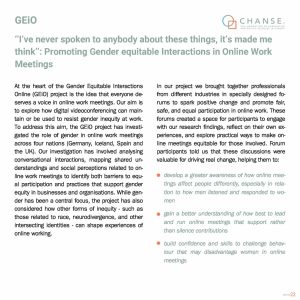
The GEiO project investigates the role of gender in online work meetings across four countries: Germany, Iceland, Spain, and the UK. With the rapid rise of digitally mediated work and widespread use of online meetings in recent years, many organisations remain unprepared to address gendered dynamics in professional digital spaces. A key aim of this project was to build new transnational evidence on the currently unexplored ways in which digital videoconferencing innovations can be used to support or resist gender inequity at work. The project employed three complementary methods. The first study analysed video-recordings of online meetings dynamics.
The second study examined understandings of online working using Q methodology. The third study used a story completion task to capture social perceptions of online meetings through narrative responses. This combination of methods, applied across four national contexts, enabled cross-national comparison and multi-level analysis of organisational dynamics.
Findings from the research include the systematic identification and analysis of interactional dynamics within videoconferencing environments (study one) that facilitate or inhibit participation. Meeting interactional practices around turn-taking, invitations to speak, interruptions, and the management of visibility and authority are shaped by gendered patterns that disproportionately affect women’s equitable engagement. Transnational comparisons showed that while understandings of the utility of online meetings are broadly similar, subtle local differences emerged in how performance and inclusivity are interpreted, particularly with regard to the emphasis placed on self-presentation (study two). These findings are reflected in broader social perceptions of gender in online meetings (study three), where women’s chairing of meetings is often seen as “out of place” within organisations shaped by masculine ideals of rational worker subjects. Associations of women leaders with emotionality, appearance and self-presentation issues was constituted as producing self-doubt. These social perceptions are important as they provide frames through which gendered subjects become positioned, negotiate their roles and shape how persistent gendered power inequalities in online leadership become broadly understood.
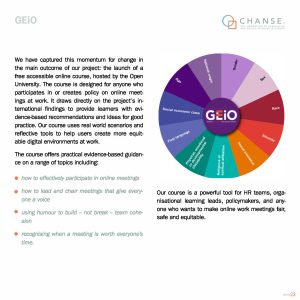
Building on the empirical findings, GEiO has generated outputs to support more equitable online work environments. The project has developed a free, badged training course on gender-equitable interactions in videoconferencing, translated into six languages corresponding to partner countries. This course is openly accessible to organisations and any professionals who use video conferencing, offering evidence-based guidance on structuring meetings, supporting leaders, and fostering inclusive participation. In addition, the project has produced a policy report with recommendations for organisations on embedding equitable practices in digital work settings. These resources connect project evidence with policy and sectoral practice. This project has generated innovative theoretical and methodological innovations, which includes a system for comparing and analysing interactional online dynamics in transnational contexts. Together, these outputs ensure that GEiO’s findings extend beyond the immediate project, providing accessible tools, guidance, and frameworks to improve gender equity in online professional interactions.
Publications:
- Gil-Juárez, A.; Podestá González, S. P., From Screens to Structures: A Feminist and Intersectional Analysis of Videoconferencing in Digital Workspaces Using Q Methodology, Gender, Work & Organization, 2025
- Gil-Juárez, A.; Capdevila, R.; Podestá González, S. P., El tiempo en el universo tecnopatriarcal: narrativas sobre el trabajo digital, Feminismo/s, 2025
- Gil-Juárez, A.; Podestá González, S. P., A Micro–Meso–Macro Multi-Method Design for Investigating Gender Equity in Digital Work: Methodological Reflections from a Transnational Project, Qualitative Research, 2025
- Rudolfsdottir, A.; Olafsdottir, K.; Petursdottir, G. M., “Ready for whatever the day might bring”: Analysis of stories about women leading digital meetings in Iceland, Women’s Studies International Forum, vol. 114, 2025, https://doi.org/10.1016/j.wsif.2025.103251
- Rudolfsdottir, A.; Olafsdottir, K.; Petursdottir, G. M., Gendered interactions in online meetings, 2025
- Biglia, B.; Heil, A.; Olafsdottir, K.; Castillo, M.; Bonet, J.; Davies, A., Language performance in working videoconferences: shaping and shaped by gender, Gender and Language, 2025
- Biglia, B.; Castillo, M.; Araiza Díaz, A., Agency and gender: a conversation analysis of communicative practices in online interactions, Critical Discourse Studies, 2025
- Lazard, L.; Capdevila, R.; Davies, A., Fragile Subjects: Gendered Interactional Dynamics in Online Meetings, Gender, Work & Organization, 2025
- Lazard, L.; Capdevila, R.; Davies, A., Making Sense of Videoconferencing: A Q Methodological Transnational Study of Acceptable Online Working Practice, Work: A Journal of Prevention, Assessment & Rehabilitation, 2025
- Lazard, L.; Capdevila, R.; Ascroft, E., The Online Feminine Subject: A Story Completion Analysis of Videoconference Chairing at Work, Feminism & Psychology, 2025
- Lazard, L.; Capdevila, R.; Gillett, J., Gender Equitable Interactions Online (GEIO) in Work-based Videoconferencing Settings: A Mixed-Methods Systematic Review, Open Science Framework, 2025, https://doi.org/10.17605/OSF.IO/QNMBC
 Start date
1 November 2022
 Project duration
36 months
 Project budget
€ 1 436 742
Funding organisations