



#WeAreCHANSE: A final celebration
By Luisa Nienhaus, Sara Perry and Anna Simandiraki-Grimshaw
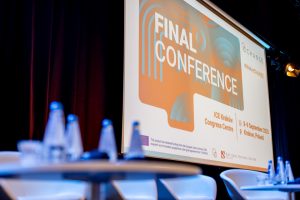
Image: Conference Stage © CHANSE, September 2025, Łukasz Bera
Outline
Under the headline of #WeAreCHANSE, we were delighted to welcome a total of 168 attendees to Kraków, Poland to attend the final CHANSE Conference held on 8-9 September 2025.
To ensure the conference programme catered for our attendees, it was developed in response to feedback from pervious conferences in Tallinn (1-2 June 2023) and Bucharest (18-19 September 2024).
At the 2025 conference, it was important to us as CHANSE Knowledge Exchange Facilitators (KEF), to provide projects with a space to celebrate their achievements and discuss the challenges they faced. To ensure that all attendees were able to join in these conversations, and in line with input from previous conference attendees, no parallel sessions were run. Instead, presentations were grouped into five thematic sessions spread across the two days:
- Digi-cultural transformation over time (Day 1)
- Digital truth making, trust and values (Day 1)
- The digital in our everyday (Day 2)
- Digital skills in society and at work (Day 2)
- The human and planetary experience in the digital age (Day 2)
Day 1
This year’s conference was opened by Prof. Patrycja Matusz, with a Keynote Speech entitled Do we need the humanities and social sciences in the time of digital revolution? The answer to this question was provided in the 26 project presentations, who clearly demonstrated this need in our digital world today.
Before individual projects took the stage, we had the pleasure to hear from the two cross-project initiatives Community Research Ethics Initiative (CREI) and Digital Resilience in Polycrises: Strengthening Adaptability in the time of the digital revolution? With CREI co-chairing a Networking session on Day 2, the project lead, Josh Edelman, took this opportunity to actively draw on attendees’ expertise and experiences in identifying areas of discussion that would be addressed the next day.
The evening on Day 1 saw an exciting departure from previous years with the launch of the first CHANSE exhibition. Here, projects had the opportunity to showcase their research in digital and physical formats. The displays ranged from animated presentations and videos to posters, policy briefs, artistic outputs and card decks.
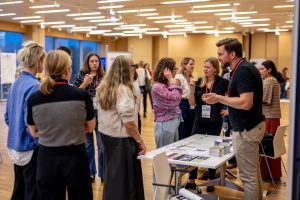
Image: Show and tell during the CHANSE conference exhibition
© CHANSE, September 2025, Łukasz Bera
The exhibition also saw the launch of another CHANSE KEF initiative. Five projects had the opportunity to co-create short videos showcasing the projects’ research. This video initiative was realised in collaboration between the CHANSE KEF team and Chocolate Films, an international video agency run as a social enterprise, based in London, UK. Funding was provided by the UK Economic and Social Research Council (ES/Y002903/2). If you are interested in watching the videos, please access them on our website here.
Overall, the exhibition was well received, and the opportunity to engage more casually and creatively with researchers and projects was welcomed.
Day 2
After the first project presentation session on Day 2, the day continued with the Networking session Research ethics procedures in the digital age. The session was co-chaired by CHANSE-KEF lead Sara Perry and CREI lead Josh Edelman and it had two main aims:
- Ensure that researchers get to know one another and have the opportunity to expand their networks.
- Support the CREI project in identifying reoccurring ethical challenges and themes faced by CHANSE funded projects. These insights should aid CREI in developing a common ethical framework and policy guidance for funding bodies and research institutions across Europe.
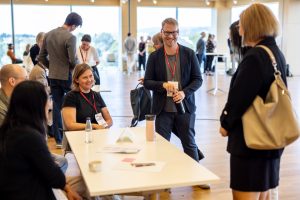
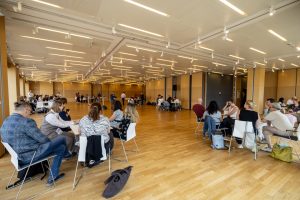
Images: Engaged attendees at the CHANSE networking session
© CHANSE, September 2025, Łukasz Bera
Facilitating networking opportunities is one of the key objectives for us at CHANSE KEF. Out of those who provided feedback on the networking session (n=26),
- 3% of respondents indicated that that they met someone new, and
- 1% of respondents indicated that they are likely to follow up with their new connection(s).
Following further project presentations, the day closed with an outlook on the new partnership funding opportunity: Social Transformations and Resilience (STR). The STR programme is coordinated by NCN (also the coordinators of CHANSE) and forms an exciting new opportunity for projects and colleagues to carry on their collaborations.
Overall, attendees were happy with their conference experience, providing positive feedback on the conference organisation and on learnings provided via the project presentations and other opportunities provided in Kraków. Some attendees even mentioned that they felt that their overall conference experience was better at the final conference in Kraków than at previous CHANSE conferences. These insights show us that our continued consultation with attendees and reflections on their feedback, helped to develop a programme which, within its pre-defined boundaries, catered for people’s diverse needs.
Reflections and Projections
With projects gradually coming to an end, it must be acknowledged that much has been achieved. The 26 CHANSE projects have demonstrated the need for, and showcased the significance of, transnational collaborative work in the humanities and social sciences. The requirement for knowledge exchange between academics and external partners allowed CHANSE projects to identify and tackle real-world problems for the public good.
Kraków represented the last cross-CHANSE in-person, however CHANSE is not over yet! There are going to be more opportunities to engage and stay involved over the coming months, so watch this space!
Acknowledgements
We, the CHANSE-KEF Team, would like to say thank you to the CHANSE coordination Office (NCN) for all the hard work they put into hosting the 2025 conference. Their support allowed us to focus on the development and implementation of the conference programme, as described above.
We would also like to thank our conference hosts and session moderators in Kraków for encouraging and facilitating dialogue amongst the presenters and the audience. And, of course, thank you to our presenters and attendees who brought the event to life.